A slab leak announces itself indirectly: a meter that moves with everything off, a warm spot on the floor from a hot line, a bill climbing without a cause, flooring that buckles, softens or smells of mildew.
Problem: A slab leak announces itself indirectly: a meter that moves with everything off, a warm spot on the floor from a hot line, a bill climbing without a cause, flooring that buckles, softens or smells of mildew.
Solution: The meter test is the owner's proof: shut everything down, read the meter, wait, read again. Movement is loss, and its pace sizes the leak before any professional instrument comes out of the truck.
When to call: Detection locates; then the decision is repair the spot or reroute the run - made from the pipe's condition at the opening and the line's leak history, not from fear or from habit.
A large share of Wichita's postwar and suburban housing sits on concrete slabs, with water lines run in or beneath the pour. It is a sound way to build - until a line fails down there, where the leak's evidence must travel through concrete, flooring and weeks of denial before it reaches the household. The owners who catch slab leaks cheaply are the ones who learn the indirect language these leaks speak. This guide teaches that language, the simple test that confirms it, and the decision that follows a confirmed, located leak.
The Wichita Angle
Start with the water itself. Wichita's municipal supply - drawn from Cheney Reservoir and the Equus Beds aquifer - arrives hard, carrying a mineral load that precipitates out wherever water is heated or left standing. Scale builds inside water heaters, narrows old galvanized lines, crusts faucet aerators and shower heads, and shortens the life of every appliance valve in the house. Plumbing in Wichita is therefore never just about pipes; it is about what the water does to them, year after year.
The indirect evidence, sign by sign
The meter is the leak's first and most honest witness. A slab leak runs twenty-four hours a day, indifferent to the household's schedule, and the meter counts it faithfully. Owners discover it as arithmetic: a bill that climbs across two cycles while habits stand still, usage that makes no sense against the household's size. Paired with the meter test described below, the bill stops being an annoyance and becomes a measurement - the leak's flow rate, readable by anyone with ten quiet minutes.
The floor itself testifies in the leak's local dialect. A hot-water line leaking under the slab warms the concrete above it - the barefoot-warm spot in the hallway that no vent explains. A cold line's leak spreads damp instead: flooring that buckles or softens, baseboards that swell, carpet that smells of mildew in a house with no other moisture story, tile grout that darkens along a line. Sound joins the testimony at night, when the house is quiet: a hiss or a rush in the floor or the wall, water running in a house where nothing is open. Each sign alone is a suspicion; any two together are an appointment.
The meter test, done properly
The test's discipline is its completeness. Turn off everything that uses water - every fixture, the ice maker, the irrigation, the water softener's regeneration if you can - and note the meter's reading, including its low-flow indicator, the small dial or triangle that betrays movement too slow for the main numbers. Then wait: an hour at minimum, a night if the household can arrange it, using no water at all. Any movement is loss, and the low-flow indicator's pace roughly sizes it - a spin is a broken line's urgency, a creep is a weep that still bills by the month.
The test also bisects the problem if you use the house shutoff. Close the house's own valve and repeat: if the meter stops, the loss is inside the house's system - slab lines included; if it keeps moving, the service line between meter and house is the suspect, a different leak with a different address in the yard. That single distinction, earned with two readings and one valve, is the first thing a detection visit would establish, and the owner who arrives with it has bought the professional's first hour for the price of ten minutes.
PROBLEM
→
SOLUTION
Repair the spot, or reroute the run
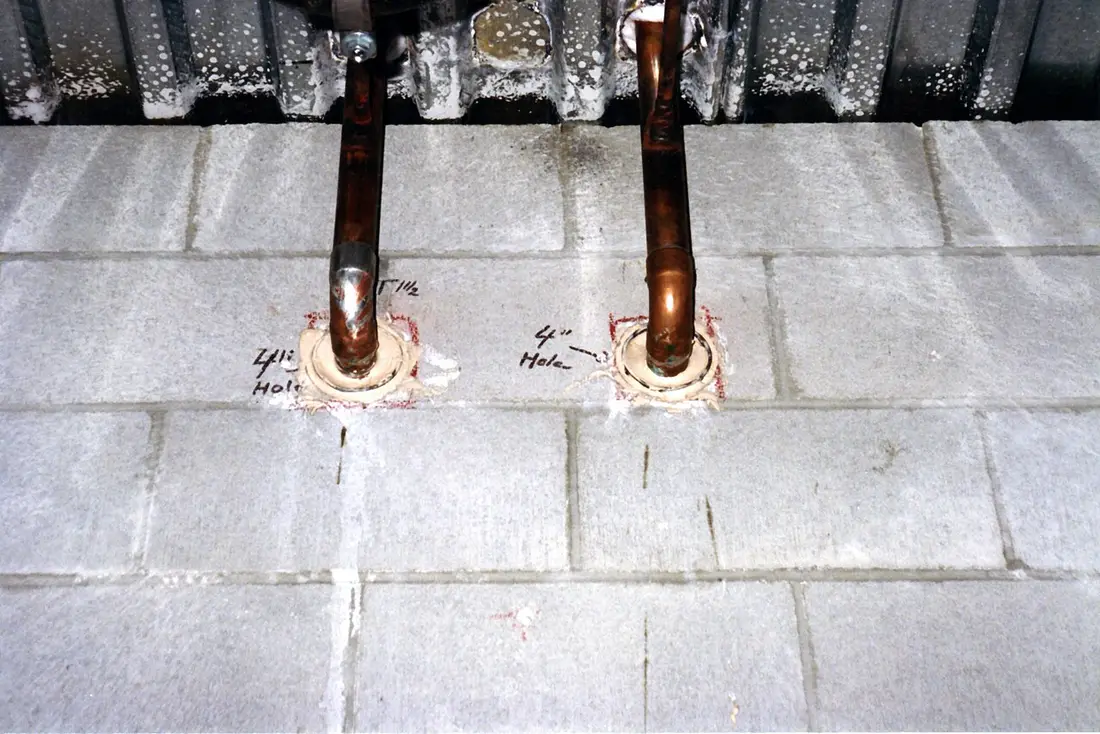
Once detection marks the leak, the concrete opens at the mark and the pipe finally testifies in person - and its testimony governs the decision. A sound line with a single failure - a fitting that gave, a section chafed by a stone in the pour - earns the spot repair: the break is renewed and the slab made whole. The same opening on pipe that is pitted, thinned or corroded along its visible length tells a larger story: the material is at end of life, and today's spot is merely its first announcement.
Rerouting is the answer to the larger story: the run is abandoned in the slab and re-piped overhead or around it, through attic or wall paths where its next fifty years are inspectable. Owners flinch at the reroute's scale until they price the alternative honestly - a sequence of slab openings across the coming years, each with its detection, its concrete, its flooring. The leak's location matters too: a failure under the kitchen's tile argues differently than one under replaceable carpet. The decision is real, which is why it is made from the opened pipe's evidence and the line's history, and why any recommendation offered before the opening deserves a raised eyebrow.
Slab Construction, or Why the Lines Are Down There
The slab era built Wichita's suburbs fast and honestly: lines run in trenches beneath the pour, or in the pour itself, rise at the fixtures and serve a house with no basement to house them. The arrangement trades inspectability for economy - there is no crawlspace to walk, no basement ceiling to read - and for decades the trade is a good one. Its cost arrives only with age, when a line's failure must announce itself through concrete, and the announcement's delay is measured in the flooring and soil damage that accumulate while the evidence climbs.
Knowing the arrangement changes how an owner reads the house: the water's path is knowable - meter, front wall, the wet rooms' alignment - and the warm spot or the damp line on the floor reads against that path like a word against a sentence. Owners who learn their slab's rough plumbing geography interpret its small signs years earlier than owners for whom the floor is a sealed mystery.
The Reroute, Considered as Architecture
A reroute is often described in repair language, but it is really a small act of architecture: the house's water supply is redrawn from an uninspectable medium to an inspectable one. The new runs live in walls and attic, where their next half-century can be seen, reached and renewed in sections. Owners weighing a reroute against a second or third spot repair should price that transformation honestly - not merely the leaks avoided, but the category of surprise retired.
The redraw has its own disciplines: freeze protection for attic runs in a Kansas January, insulation as a designed feature rather than a retrofit, shutoffs placed where the next generation will thank you for them. A reroute specified with those disciplines is the slab house's plumbing growing a basement's virtues without the basement - which is, in the end, the entire argument for it.
Myth vs Fact
The Myth
A slab leak means the whole house must be re-piped immediately. The diagnosis sounds total, and fear - sometimes assisted by a sales quota - generalizes one failure into a system verdict.
VS
The Fact
One leak is a datum; the pipe's condition at the opening and the leak's history make the verdict. Sound pipe with a single failure earns a spot repair that can serve for years. Patterned failure in corroded stock earns the reroute. The opening is the evidence, and any verdict delivered before it is a guess in a uniform.
The Related Service, In Depth
Detection is the plumbing trade's purest information product: nothing is fixed, and everything is changed. A house with a marked leak and its evidence file has converted dread into a scope - the repair can be quoted, scheduled and compared - while a house with an unlocated leak owns only the meter's accusation. The value of the mark is precisely the size of the guessing it retires.
That is the service side of this guide's subject. When you are ready, the Leak Detection page carries the process, the coverage by neighborhood and the number to call.
The Process, Step by Step
Run the meter test
Everything off, two readings, the low-flow indicator watched. Then the house-shutoff bisection. Write down both results and their times.
Map the floor signs
Walk the house barefoot for warm spots; note soft, buckled or odorous flooring and any night sounds. Mark them on a rough floor plan - the detection visit starts from this map.
Have the leak located, with evidence
Pressure isolation narrows the territory; acoustic work marks the spot; the mark arrives with its confidence stated. Do not authorize concrete on less.
Decide from the opened pipe
Spot repair for the sound line's single failure; reroute for the material's general failure. The pipe at the opening is the witness - let it speak before the scope is final.
Prevention Checklist
Read the meter twice a year with everything off and record it; the baseline is what makes a leak's first month visible instead of its sixth.
Keep the bill history; a two-cycle climb with steady habits is a leak accusation from the utility's own arithmetic.
After any slab repair, file the detection report - a second leak's meaning depends entirely on the first one's paperwork.
Walk slab floors barefoot seasonally; your feet are calibrated warm-spot instruments you already own.
Know the house shutoff and the meter shutoff both - a located leak you cannot stop is only half located.
A Field Checklist for Your Own Home
Run the meter test twice a year, everything off, and record both readings with dates.
Bisect with the house shutoff at the first suspicion: house side or service side, in ten minutes.
Walk the floors barefoot each season; log warm spots, soft spots and smells on a rough plan.
Never authorize concrete without a located mark, its evidence and its confidence stated.
What the Paperwork Should Show
The spot repair's scope is a paragraph; the reroute's is a chapter, and the chapter deserves reading before it is signed: which runs move, by what path, with what freeze protection and shutoff placement, and what the slab's opened section receives - repair, abandonment, a clean cap. A reroute scoped in that detail is architecture; scoped in a sentence, it is a promise that will be renegotiated by the walls it meets.
Either scope ends with the same deliverable: the updated house file. The detection report, the mark's location measured from fixed points, the opened pipe's photographs, the scope performed - the next leak, if the line ever speaks again, begins from this file instead of from a new round of dread, and that difference alone is worth the folder it sits in.
How a Professional Works This Problem
A professional slab-leak engagement is an evidence chain: the meter and pressure tests isolate the territory with numbers, acoustic work along the traced path converges on the mark, and the mark is delivered with its confidence graded and its alternatives stated. The repair that follows - spot or reroute - is scoped from the opened pipe's testimony, and the whole chain lands in the property file. The professional product is the chain itself; any weak link converts the job back into guessing.
Mistakes That Make It Worse
Breaking concrete on an ungraded hunch - the slab remembers every hole.
Accepting a verdict of 'repipe everything' before the first opening has testified.
Ignoring the bill's two-cycle climb because the floors still feel dry.
Repairing the spot and discarding the detection report, leaving the pattern - if one forms - undocumented.
The Bottom Line
A slab leak speaks indirectly, but it speaks constantly - in the meter's creep, the floor's warmth, the bill's arithmetic. Owners who learn the dialect catch it in its cheap chapter, when the choices are still a spot and a patch. The concrete hides the pipe; it cannot hide the evidence, and the evidence, read early, is the whole game.
A sump system is four parts with one job: the pit collects, the pump lifts, the check valve holds the lift, and the discharge delivers the water somewhere it stays. A failure in any one is a system failure.
Wichita's supply, drawn from Cheney Reservoir and the Equus Beds aquifer, carries a real mineral load - the city's water is hard, and every heated or slowed drop leaves a deposit behind in your plumbing.
Can a slab leak really raise my water bill that much?
Yes, and the mechanism is simple duration: unlike a dripping faucet, a pressurized line under the slab leaks at full pressure around the clock, including the weeks before its signs surface. Even a modest weep runs to thousands of gallons a month; a split fitting runs like a faucet nobody turns off. The bill is often the leak's first measurable sign, which is why the meter test follows the bill's accusation so reliably.
Will the leak damage the slab or the soil under it?
Over time, yes - escaping water erodes the soil and sand base beneath the pour, and the slab above a washed-out pocket can settle or crack; the moisture also feeds the flooring damage and mildew that owners notice first. This is the argument for treating a confirmed slab leak as a prompt project rather than a monitored one: the leak is excavating while it leaks.
How accurate is leak detection, really?
A competent detection, working from pressure isolation and acoustic evidence, marks most pressurized slab leaks within a small area - and an honest one grades its confidence when soil, depth or a very small weep makes the ground keep secrets. Judge the product by its evidence statement, and be wary of any mark offered instantly, from the doorway, without the tests that produce it.
Is it better to reroute preemptively if my lines are old?
Only where the evidence has started: one leak repaired in sound pipe buys information cheaply, and the line may serve quietly for years. A pattern - a second leak, corroded stock at the first opening - converts preemptive from anxious to arithmetic. The reroute decision is best made with at least one opening's worth of testimony in hand.
Please note: Wichita Plumbing Pros is an independent directory and referral service, not a plumbing contractor. The professionals reachable through this site are independent businesses; any agreement for work is between you and the professional you engage. Service information on this site is general educational material - the scope of any real plumbing work is set by an on-site inspection.
A Burst Pipe, a Backed-Up Drain or a Water Heater Gone Cold?
One call connects you with a plumbing professional serving Wichita and the surrounding communities - diagnosis, repair and a clear scope before work starts.