Wichita Plumbing Services

Garbage Disposal Repair in Wichita, KS

Garbage disposal repair and installation in Wichita - jammed flywheels, leaking seals, dead motors, and honest counsel on the hard-water loads a disposal can and cannot take.

The housing stock writes the third chapter. Wichita grew in eras, and each era plumbed differently: galvanized steel and cast iron with clay sewer laterals in the prewar core; copper supply and slab foundations in the postwar decades; plastic supply and drains in the newer suburbs, with water heaters cycling through all of it on their own shorter clocks. A plumber reading a Wichita house starts by reading its decade, because the decade predicts the pipes, the failure modes and the honest order of repairs.

Then there is the weather's direct line into the system. Spring storms drop rain faster than old laterals can carry it, low river-adjacent ground floods basements and asks sump pumps for their year's work in a weekend, and summer drought pulls the clay away from buried lines until the fall rains swell it back against them. Storm season, freeze season, drought season - Wichita plumbing runs on all three calendars at once, and the pages here are organized around exactly that.

Signs You Need Garbage Disposal Repair

The disposal hums but does not grind

Power reaches the motor and the flywheel will not turn - the classic jam, usually a bone fragment, a bottle cap or yesterday's optimism wedged at the plate. The hum is a countdown: cut the power before the motor cooks itself proving the point.

It does nothing at all - silence when switched

Silence is information too: the overload protector has tripped on a past jam, the outlet or switch has failed, or the motor has finished. The reset button under the unit settles the first suspect in ten seconds, in the right order of operations.

Water leaks from the bottom of the unit

A leak at the chamber's base is the internal seal's resignation - the one leak that is not a repair. Water through the motor housing is the unit announcing its replacement; everything above the unit, by contrast, is connections, and connections renew.

It roars, rattles or shakes the sink

Noise is wear made audible: bearings at their end, a grind plate corroding loose, or a foreign object still in residence. New noise from an old unit is its condition report, delivered loud enough to act on.

Drains slow and smells linger despite grinding

The disposal is one room in a longer house; a drain downstream that scale and grease have narrowed makes the unit seem lazy, and the smell is the drain's biofilm, not the grinder's. The visit sorts which address the problem lives at.

It trips the reset or the breaker repeatedly

A protector that keeps firing is a motor drawing like a failing motor - or a jam half-cleared, still binding. Either way the repetition is the diagnosis narrowing itself: this is no longer a reset, it is a decision.

Why Garbage Disposal Repair Is a Standing Job in Wichita

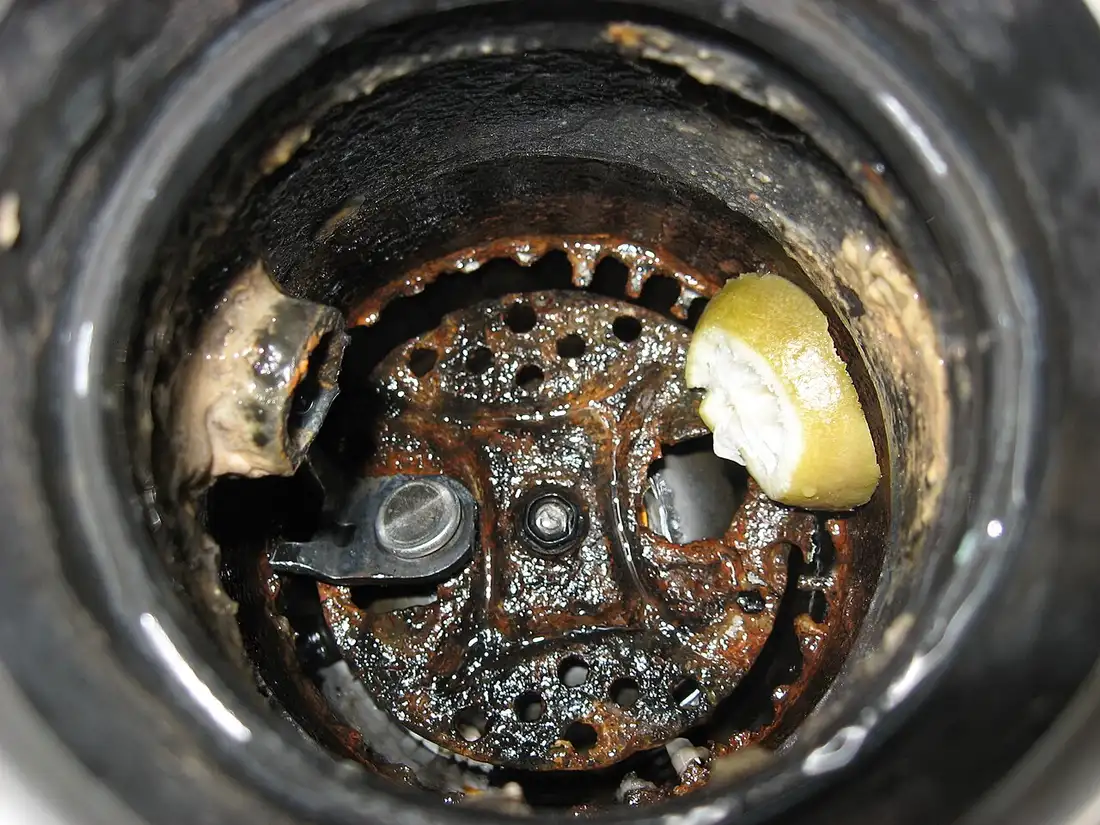
The jam is the disposal's daily bread, and its mechanics are worth understanding: the flywheel spins the impellers that sling food against the grind ring; a hard fragment wedges between plate and ring and the flywheel stops while the motor strains. The hex socket on the unit's underside exists for exactly this - turned by hand with the power off, it walks the flywheel free. A disposal that jams on ordinary loads, though, is not unlucky; it is worn, its ring and plate dulled past grinding into merely stirring.

Leaks sort by altitude, and the sorting is the whole skill. Top leaks - flange and dishwasher inlet - are seals and connections, renewed in place. Middle leaks at the discharge are gaskets and alignment. The bottom leak is the verdict: the chamber's internal seal, unserviceable by design, venting through the motor. Owners who learn the altitude rule stop fearing the word leak and start asking the only question that matters about one: from how high up?

What a disposal should eat is a shorter list than kitchen legend claims. Wichita's sweet-corn husks, onion skins and pasta's expanding starch defeat the grind and pave the drain; grease poured warm arrives at the clay-era drain's cold section and sets. The unit handles plate scrapings and soft scraps in cold running water, in small loads - a seasoning to the drain system, not its main course. The disposal that is fed like a trash can dies like one, and takes the drain's temper with it.

Garbage Disposal Repair Through the Wichita Year

Spring is storm season in Wichita, and it is plumbing season too. From March into June, heavy plains rain tests every drain and lateral in the county: sump pumps run for days on the low ground, older sewer lines surcharge where storm water finds its way in, and the basement fixtures of river-adjacent neighborhoods learn where they stand relative to the street sewer. Spring is also when winter's hidden damage declares itself - the line that froze and split behind a wall, weeping quietly since January.

Summer splits in two: the storm tail of June, when the last big rains finish the season's argument with the drains, and the long bake that follows. In the bake, the clay soil dries and shrinks away from buried laterals, opening joints that will drink the fall rains; irrigation systems run daily and expose every weak backflow and split lateral line; and water heaters work their steadiest hours supplying the season's showers and laundry. A leak in summer is a water bill discovered in August.

Wichita winters swing: mild weeks, then an Arctic front that parks single-digit cold over the plains for days. Pipes in exterior walls, crawl spaces and unheated garages freeze in rough order of their exposure, and the burst usually announces itself at the thaw, not the freeze. The holiday weeks load the other half of the system - disposals, dishwashers and guest-bathroom drains at their annual maximum. Winter plumbing is triage: stop the water, then read what the cold actually did.

Garbage Disposal Repair in Depth

The disposal is a small machine with an honest culture problem: it is marketed by its appetite and judged by its restraint. Nearly every premature disposal death traces to the gap - the husks and starch and grease it was fed because its name promised capacity, grinding in water that scaled its parts while the drain below received the overflow of its promises. The repair visit that changes the feeding rules is worth more than the one that changes the unit.

Its failures are also unusually legible, which makes the disposal a good teacher. The hum, the silence, the drip's altitude, the reset's behavior - each is a sentence in a language owners can learn in one visit. A household that can read its disposal can read most of its plumbing's smaller failures, and the confidence that follows is the opposite of helplessness at the sound of a strange noise under the sink.

Choosing the Right Help

Choose the disposal visit that reads the failure aloud - hum, silence, leak altitude - and repairs or replaces by that reading, not by the age of the unit or the stock on the truck. The disposal is a small job that reveals a large trait: whether the provider diagnoses or merely swaps. File the answer for the bigger jobs.

The Ground and Water Behind It

Start with the water itself. Wichita's municipal supply - drawn from Cheney Reservoir and the Equus Beds aquifer - arrives hard, carrying a mineral load that precipitates out wherever water is heated or left standing. Scale builds inside water heaters, narrows old galvanized lines, crusts faucet aerators and shower heads, and shortens the life of every appliance valve in the house. Plumbing in Wichita is therefore never just about pipes; it is about what the water does to them, year after year.

The ground is the second author of Wichita plumbing. Much of Sedgwick County sits on expansive clay that swells when wet and shrinks in drought, and that slow breathing moves everything buried in it: sewer laterals sag and separate at the joints, service lines flex at their fittings, and slab foundations transmit the motion to the pipes inside them. Add the freeze-thaw winters, when shallow lines and unheated crawl spaces meet single-digit nights, and the county's buried plumbing works harder than the plumbing itself ever planned to.

How Garbage Disposal Repair Works

Identify the failure by its evidence

Sound, silence, leak altitude and reset history sort the case into jam, electrical, connection or unit failure before a wrench turns.

Clear, reset or renew what is honestly renewable

Jams are walked free and the chamber inspected for the culprit and the wear it rode in on; seals and connections are renewed where the leak's altitude allows.

Replace the unit when the evidence says the unit

A bottom leak, a cooked motor or roaring bearings close the repair case; the replacement is mounted, sealed, wired and proven under load.

Prove the whole sink, not just the unit

Disposal, trap and drain are run together under water - the new quiet is verified, and you get the feeding rules that keep it quiet.

Doing It Yourself vs a Professional

The DIY Route

  • Reaching into the chamber with fingers - ever, running or not - is the disposal's one genuinely dangerous idea; the flywheel frees from below, by hand, power off
  • Resetting the protector repeatedly into a jammed unit converts a free jam into a cooked motor at reset-button speed
  • Pouring drain chemicals into a dead disposal fills a chamber someone must then open by hand, and eats the seals on its way through
VS

The Professional Route

  • Sorts the failure by evidence - hum, silence, leak altitude - before prescribing anything
  • Repairs the renewable without apology and replaces the finished without drama
  • Proves the whole under-sink system under water and leaves the feeding rules that protect the drain downstream

Keep It From Coming Back

Disposal prevention is dinner-party simple: what goes in, in what water, in what amounts. These habits are the unit's lifespan written as kitchen rules.

  • Run cold water before, during and after grinding; cold keeps grease solid to be ground and carried, where warm water paints it onto the drain.
  • Feed small loads in sequence rather than a sinkful at once - the chamber grinds a stream, not a landslide.
  • Keep the true enemies out: husks, skins, bones beyond small, grease, and starch loads that swell in the drain below.
  • Grind a tray of ice with cold water now and then; it scours the chamber's scale and keeps the splash zone honest.
  • Check under the sink monthly with a dry hand on the unit's base - the bottom leak caught at a weep is a planned purchase, not a ruined cabinet.
Garbage Disposal Repair in the Surrounding Communities

The communities around Wichita share its water, its clay and its freeze-thaw winters - with their own twists of housing era, slab construction and well-and-septic edges.

Garbage Disposal Repair in Clearwater

Clearwater is a small railroad-era city southwest of Wichita on the Chikaskia River, with a historic downtown and a mix of older homes and new subdivisions drawing commuters to the metro. Its older streets keep plumbing as old as the town; its edges run wells, septic systems and long rural lines.

Garbage Disposal Repair in Mulvane

Mulvane is an old railroad town south of Wichita on the Arkansas River, with a preserved Main Street and depot, newer growth near the Kansas Star Casino, and a strong small-city identity. The river's low ground frames the town - and keeps its basements, laterals and sump pumps busy.

Garbage Disposal Repair in Rose Hill

Rose Hill is a growing Butler County town southeast of Wichita, where newer subdivisions and acreage homes have spread around its schools. It draws families who want country space within commuting range - and its plumbing splits between new subdivision systems and farmstead wells and septic lines.

Garbage Disposal Repair in Bel Aire

Bel Aire is a growing city on Wichita's north edge, built around lakes, parks and newer subdivisions along the K-254 corridor. It has grown from a small community into one of the metro's active family suburbs, plumbing each new street as it goes.

Where Garbage Disposal Repair Is Needed Most

In the historic core and the east side - Riverside, College Hill, Eastborough, Downtown Wichita, Old Town and Delano, Midtown, South Wichita, Planeview, Oaklawn - the pipe stock runs from Wichita's oldest galvanized and clay to the boom-decade copper of the postwar subdivisions, and garbage disposal repair follows that record: century-old systems in the core, mid-life stock in the subdivisions, and hard water working on all of it at the same rate.

Across the east and west growth sides and the north side - East Wichita, Northeast Wichita, Uptown Wichita, West Wichita, Southwest Wichita, Auburn Hills and North Wichita, Benjamin Hills, Northwest Wichita, Derby, Andover, Haysville - sit the slab subdivisions of the 1970s onward, the growth-edge neighborhoods and the second-generation systems now reaching their first renewals, which together make this the steadiest garbage disposal repair territory in the city.

Beyond the city line, the same work runs in Clearwater, Mulvane, Rose Hill, Bel Aire, Park City, Valley Center, Kechi, Maize, Goddard, Newton, Hutchinson - railroad towns, fast-growing suburbs and county-seat communities where acreage wells, septic systems and small-city pipe add their own chapters. Every one of these area pages carries the local detail for garbage disposal repair in that community.

Coverage, In Full

Garbage Disposal Repair runs across the whole service map: Riverside, College Hill and Eastborough; Downtown, Old Town, Delano and Midtown; East Wichita, the northeast growth edge and Uptown; South Wichita, Planeview and Oaklawn; the west side, Southwest Wichita and Auburn Hills; North Wichita, Benjamin Hills and Northwest Wichita; and beyond the city in Derby, Andover, Haysville, Clearwater, Mulvane, Rose Hill, Bel Aire, Park City, Valley Center, Kechi, Maize, Goddard, Newton and Hutchinson. One call covers all of it - the local pages above carry the detail for each. If your street is not named here, call anyway: routes grow with demand, and most Sedgwick County addresses are already within reach of a scheduled run.

From the Wichita Plumbing Guides

Sewer Lines in Older Wichita Homes: Clay, Roots and the Camera

Older Wichita homes drain through clay tile or cast-iron laterals whose sections are sound but whose joints - opened by decades of expansive-clay movement - admit the roots that do the visible damage. The failure sequence is almost always: joint opens, moisture escapes, root arrives, blockage builds. Clearing treats the last step; the camera reads all four and tells you which step your repair dollar belongs to.

Read the Guide

Water Heater Repair or Replace? The Wichita Owner's Decision Guide

The decision turns on one distinction: parts fail and are repaired; vessels fail and are replaced. A thermostat, element, valve or anode is a part. A leaking seam or tank bottom is the vessel announcing itself. Wichita's water moves the threshold: scale and sediment age a tank faster here, so the same failure means repair on a young maintained unit and replacement on an old neglected one.

Read the Guide

Slow Drains: What Your Wichita Home Is Telling You, Room by Room

One slow fixture means the problem lives in that fixture's trap or branch. Every fixture slowing, gurgling or backing up together means the building drain or the sewer lateral - a different address and a different visit. Bathroom drains clog with hair, soap and toothpaste biofilm; kitchen drains with grease that set in the cold sections; laundry drains with lint and detergent load. The room names the recipe.

Read the Guide

Garbage Disposal Repair Questions

Why does the reset button keep popping?

The protector is a thermometer with authority: it trips on the heat of a straining motor. A single trip after a jam is its job description. Repeated trips mean the strain persists - a half-cleared jam, a bearing dragging, a winding failing - and each reset into that strain spends the motor's remaining life faster.

Can a disposal cause the sink to drain slowly?

It can share the blame but rarely owns it: a worn grind ring leaves food coarse, and coarse food in a narrowed drain stacks up. The slow drain's true address is usually downstream - the trap and the branch the unit discharges into - which the visit proves by running the system apart and together.

Is it safe to use the disposal with a septic system?

On the acreage edges of the county, disposals and septic coexist with respect for the tank's arithmetic: ground food is extra load the tank must digest, and heavy disposal use shortens the pumping interval. Modest use, honest feeding rules, and the tank's schedule adjusted accordingly is the working compromise most septic homes settle into.

What affects the cost of disposal replacement in Wichita?

The unit's size class and construction, the condition of the flange and mounting it inherits, whether the dishwasher inlet and discharge need renewal while access is open, and the drain's temper downstream. The unit on the shelf is the known part; the under-sink reality it joins is the variable, and it is read in the first visit's minutes.

Why does my disposal hum but not spin in Wichita?

A jammed flywheel with a live motor: something hard has wedged the plate, the motor strains against it, and the hum is the sound of a countdown to a cooked winding. Power off first. The flywheel frees by hand from the hex socket underneath, and the culprit - once fished out with tongs, never fingers - usually explains the whole event. If the unit jams again on ordinary loads, the wear verdict supersedes the jam verdict.

Water drips from the bottom of my disposal in Wichita. Can it be sealed?

No - and that single no saves owners real money. The bottom leak is the internal seal failing into the motor housing; the chamber is not serviceable, and the unit is finished. Every leak above the base - flange, inlet, discharge - is connections and seals, all renewable. Altitude is destiny under a sink: locate the drip's height before accepting any verdict, including this one.

How long should a garbage disposal last in Wichita?

Its years follow its diet and the water: a unit fed plate scrapings in cold water, in a house that keeps grease out, reaches the long end of the usual range; a unit fed like a trash can in hard water, grinding husks and starch, retires early and complains loudly on the way. The replacement conversation goes best when the feeding rules change with the unit.

My disposal died - do I need the same size again in Wichita?

Size follows the household's cooking, not the old unit's label: batch size, the cook's ambitions and the drain system's age all argue. An older Wichita drain system actually prefers a modest unit's gentler output over a powerhouse's surge. The sink's mounting is standard across the common sizes, so the choice is genuinely free - make it on the kitchen's real habits.

Please note: Wichita Plumbing Pros is an independent directory and referral service, not a plumbing contractor. The professionals reachable through this site are independent businesses; any agreement for work is between you and the professional you engage. Service information on this site is general educational material - the scope of any real plumbing work is set by an on-site inspection.

A Burst Pipe, a Backed-Up Drain or a Water Heater Gone Cold?

One call connects you with a plumbing professional serving Wichita and the surrounding communities - diagnosis, repair and a clear scope before work starts.

📞 Call Now
📞 Call Now