Tankless units heat water as it flows, so their limit is rate, not volume: the sizing question is how many fixtures run at once in January, when inlet water is coldest and every unit's capacity is at its yearly low.
Problem: Tankless units heat water as it flows, so their limit is rate, not volume: the sizing question is how many fixtures run at once in January, when inlet water is coldest and every unit's capacity is at its yearly low.
Solution: Wichita's hard water is the format's local tax: heat exchangers scale, capacity fades, and the annual descale - with service valves fitted at installation - is the non-negotiable rent on the technology's long life.
When to call: The fit is a profile, not a pitch: households with deep-but-staggered demand, space pressure, or long absences win; households with heavy simultaneous demand and no appetite for annual maintenance are a tank's natural constituency.
The tankless pitch is the most seductive sentence in plumbing: hot water that never runs out. It is also, in its honest form, a more interesting sentence - hot water that never runs out, at a rate, in a season, under a maintenance rhythm. Wichita grades that sentence strictly. Our winters chill the incoming water to the point where every unit's real capacity bottoms out exactly when demand peaks, and our hard water scales heat exchangers with an agenda. This guide is the full sentence: how the format works, the arithmetic that sizes it, the ownership it actually involves, and the households it genuinely fits.
The Wichita Angle
The housing stock writes the third chapter. Wichita grew in eras, and each era plumbed differently: galvanized steel and cast iron with clay sewer laterals in the prewar core; copper supply and slab foundations in the postwar decades; plastic supply and drains in the newer suburbs, with water heaters cycling through all of it on their own shorter clocks. A plumber reading a Wichita house starts by reading its decade, because the decade predicts the pipes, the failure modes and the honest order of repairs.
Flow, not volume: the arithmetic that replaces the tank
A tank is a savings account: capacity is what it holds, and running out is an empty account. A tankless unit is an income: capacity is what it earns per minute, and running out is a queue - more fixtures drawing than the flow can serve at temperature. Every fixture has its rate - a shower, a washer, a tub filler at its generous worst - and the unit must meet the sum of the ones that truly overlap. The sizing discipline is therefore an interview with the household's mornings: who showers when, what runs concurrently, which fixtures are the honest simultaneous set.
Then Kansas applies its correction. A unit's flow rating assumes a temperature rise; the colder the inlet, the more of the unit's fire goes to the lift and the less flow remains at temperature. Wichita's January inlet water asks for nearly the largest lift of the year - the unit's rated capacity can fall by a third or more against its mild-weather figure, in precisely the weeks when the house wants its longest showers. Honest sizing is done at the winter number, and any proposal that quotes only the brochure's gentle-climate figure is scheduling a December complaint with your name on it.
Scale: the rent this water charges the format
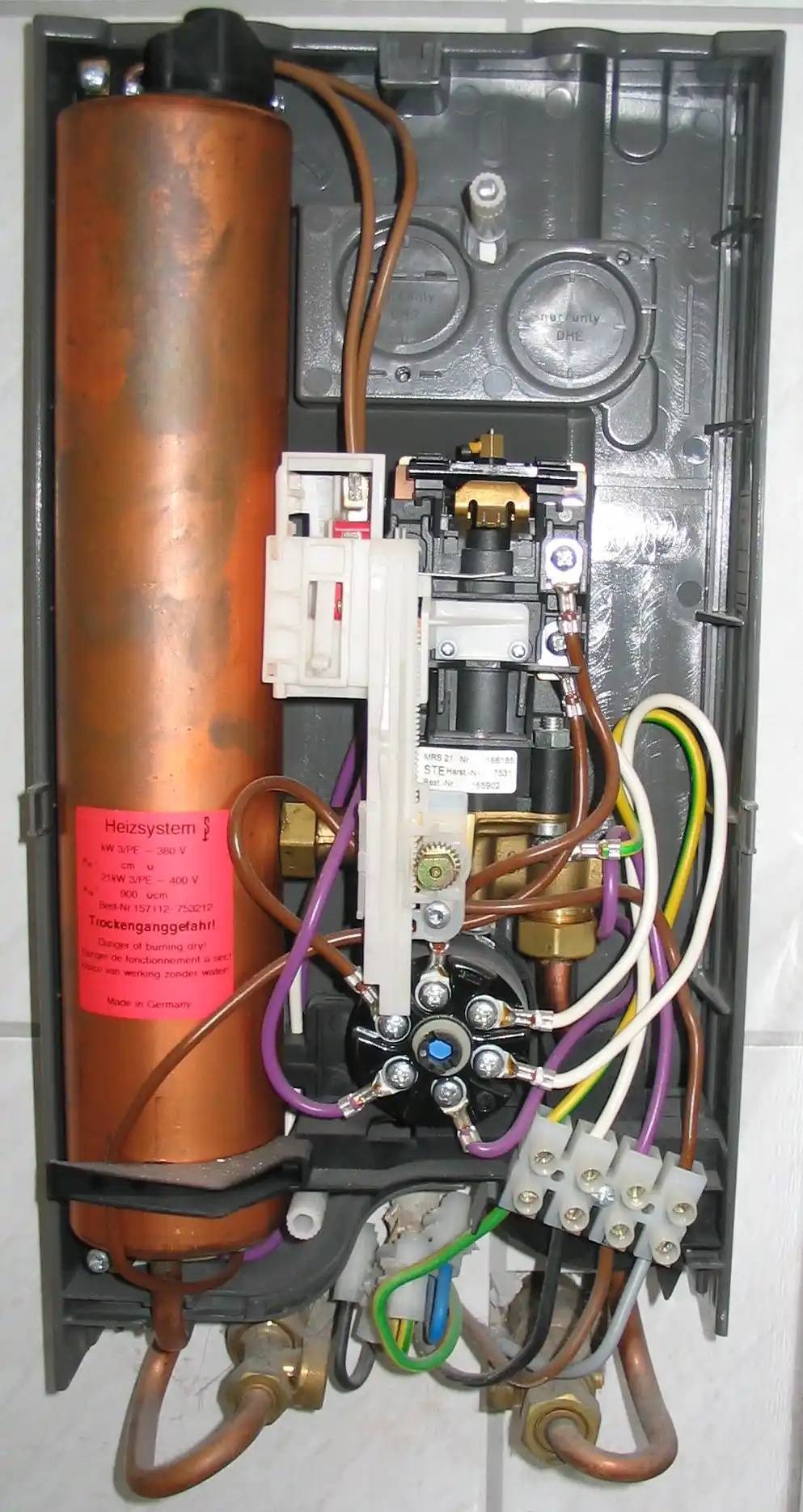
A heat exchanger is a set of narrow, hot passages - which is to say, a machine designed by geometry to collect Wichita's minerals at the exact point of maximum heat. Scale coats the passages, insulating the water from the fire and narrowing the flow, until the unit's capacity fades and its error codes begin their testimony. This is not a defect of the format; it is the format's physics meeting the local water, and the meeting has a scheduled resolution: the descale, a service visit that circulates a dissolving solution through the exchanger and returns it to its first-year surfaces.
The descale's ease is decided at installation, by the service valves - the isolation fittings that let a technician loop the unit without disturbing the house's plumbing. With them, the annual visit is routine; without them, it is a project, and the difference is an hour of installation foresight. Owners should also hear the companion commitments plainly: the inlet screen kept clean, the unit's error history respected rather than reset into silence. Tankless units maintained on this rhythm are long-lived; the same units ignored in this water are a countdown wearing a warranty.
PROBLEM
→
SOLUTION
The fit: profiles that win, profiles that should keep the tank
The winning profiles share a shape. Demand that is deep but staggered - the household that takes four long showers in sequence and never simultaneously - feasts on flow it would have rationed from a tank. Space-starved homes reclaim a closet or a garage corner from the wall-hung unit. Part-time residences and long-absence households stop paying standby losses to heat water for an empty house. And owners who genuinely enjoy a maintained appliance - who will descale yearly the way they service a furnace - collect the format's long service life as their reward.
The tank's constituency is equally honorable. Households whose peaks are a pile-up - two showers, the tub, the washer and the kitchen in one defiant quarter-hour - may need capacity that prices the tankless answer past reason, or two units where one tank sufficed. Owners who want their water heater to be the house's most ignorable appliance should keep the vessel that tolerates ignoring. And houses whose gas or electrical service cannot feed the format's appetite without major work may find the infrastructure eats the advantage. The guide's last word is the audit's: let the winter arithmetic, the water's tax and the household's honest habits vote - and buy the format that wins your house, not the showroom.
The Hybrid Middle: When Neither Format Wins Outright
Some houses split the verdict, and their owners should hear that the formats compose. A tank serving the house's steady base load with a tankless point-of-use unit at the distant bathroom ends the long wait for hot water that long pipe runs impose. A small tank added to a tankless system buffers the cold-water sandwich and steadies simultaneous draws. These arrangements look indecisive on a brochure and read as engineering in a house whose demand map has two different shapes on it.
The middle arrangements share the audit's signature: they begin from the household's measured pattern rather than from format loyalty. Households are rarely pure types, and a guide that pretends otherwise sells cleaner stories than the plumbing deserves. The map first, the format second, the hybrid where the map says so - that ordering is the whole method.
Error Codes: The Unit's Own Testimony
A tankless unit is the rare appliance that testifies: its error codes name the failing system - ignition, flame, venting, flow, scale's thermal signature - in a vocabulary the manual translates. Owners who learn to record the code before resetting it hand the service visit its first chapter, and owners who reset reflexively are shredding the unit's testimony nightly. The habit is worth adopting across modern appliances generally, but the tankless rewards it most, because its codes are unusually specific and its failures unusually diagnosable.
The testimony has a calendar dimension too: codes that cluster after long draws tell the sizing story; codes that arrive with the season tell the inlet story; codes that multiply across systems tell the scale story. Read in sequence, the unit's log is the honest review of the installation's original audit - which is one more reason the audit's paperwork belongs in the house file from day one.
Myth vs Fact
The Myth
Tankless means unlimited hot water for the whole house, whatever runs at once. The pitch compresses 'unlimited duration' into 'unlimited everything,' and showrooms rarely restore the missing half of the sentence.
VS
The Fact
The limit moves from volume to rate - and rate is a budget fixtures spend. A tankless unit serves endless water at its flow rating; open more fixtures than the winter rating covers and temperature sags. Sized by the honest overlap audit, the experience matches the legend. Sized by the brochure, December files the correction.
The Related Service, In Depth
Tankless ownership has a rhythm tank ownership never taught: the appliance is maintained like a furnace, not ignored like a closet. The owners who love the format are the ones who were told this plainly at the start - descale yearly, clean the screen, know the codes - and folded the rhythm into the house's calendar. The owners who resent it were sold a fit-and-forget story that Wichita's water was never going to honor.
That is the service side of this guide's subject. When you are ready, the Tankless Water Heaters page carries the process, the coverage by neighborhood and the number to call.
The Process, Step by Step
Run the winter audit
List the fixtures that genuinely overlap on your busiest morning, and size against January's inlet temperature. The audit sometimes concludes 'tank' - trust it when it does.
Audit the services
Gas capacity at full fire alongside the home's other appliances, or the electrical panel's room for the draw, plus venting and condensate routes - priced before the model is chosen.
Specify the maintenance in
Service valves at installation, the descale scheduled as the handover's final act, the error-code basics in writing. The unit's tenth year is purchased in this step.
Prove it at the taps
Commission under overlapping demand - two fixtures running, temperatures checked - in the season of purchase if possible, with January's arithmetic already honored on paper.
Prevention Checklist
Descale yearly in Wichita water; calendar it beside the furnace service so the two maintained appliances share a rhythm.
Clean the inlet screen on schedule - a starved unit mimics an undersized one, and the screen is the easiest capacity you own.
Write down the unit's errors before resetting them; the code history is the exchanger's medical record, and it should survive to the service visit.
Re-run the flow audit before adding a bathroom or a soaking tub - the budget you sized at purchase is spent exactly like money.
Protect the unit's lines and condensate in cold snaps if it lives in a garage; freeze protection covers the appliance, not every pipe that feeds it.
A Field Checklist for Your Own Home
Count the true simultaneous fixtures and size at January's inlet temperature, on paper, before any model is named.
Verify the gas or electrical service's capacity as part of the decision, priced into it.
Specify service valves in the installation scope - the descale's ease is bought exactly once, at install.
Calendar the descale and the screen cleaning at handover, beside the furnace's rhythm.
What the Paperwork Should Show
The tankless decision's hidden scope is the house's next decade: bathrooms planned, teenagers arriving, a soaking tub in the remodel drawings. Flow budgets are spent like money, and the audit that sizes today's household to its limit has silently mortgaged the remodel. A unit sized with headroom for the house's stated future - or a plan that admits a second unit later - is the difference between an installation and an installation program, and the conversation costs nothing at audit time.
The water's scope deserves the same foresight: a household already considering softening for the whole system should sequence the decisions, because softened water changes the exchanger's scale arithmetic from an annual descale toward a gentler rhythm. Appliances are bought one at a time, but in a hard-water house they are owned as a system, and the tankless - the most water-sensitive appliance in the building - is where system thinking pays first.
How a Professional Works This Problem
A professional tankless consultation is an audit with a quote attached: the household's simultaneous-demand profile counted honestly, the winter inlet correction applied in the open, the gas or electrical service verified before any model is named, and the maintenance rhythm - descale, screen, codes - written into the proposal as a condition of the format's promise. A consultation that can conclude 'keep the tank' is the only kind whose 'go tankless' is worth believing.
Mistakes That Make It Worse
Sizing from the brochure's mild-climate flow figure and meeting January unprepared.
Skipping the service valves at installation to save an hour, and paying it back at every descale.
Resetting error codes reflexively, shredding the unit's testimony before anyone reads it.
Adding a bathroom or a soaking tub years later without re-running the flow budget.
The Bottom Line
Tankless is neither the miracle of the pitch nor the disappointment of the unmaintained. It is a format with an arithmetic - flow, lift, scale - and households whose numbers fit it, maintained on its rhythm, get the legend in full. Let the audit run your house's numbers honestly, winter first, and buy whichever format wins. The water does not care which you choose; it will grade the choice either way.
Plumbing prices are scope wearing a number: the same named job - a leak, a clog, a heater - spans a wide range because the underlying situations differ in access, condition, footage and code work.
Wichita's winter risk is the swing: Arctic air drops temperatures into the teens and single digits, then releases - and pipes burst at the freeze but announce themselves at the thaw, when the ice plug melts and the split section pours.
It eliminates standby loss - the tank's round-the-clock reheating of stored water - and that saving is real for households whose usage pattern leaves a tank idling: smaller households, staggered demand, part-time occupancy. Heavy, constant-demand households idle a tank far less, and their saving shrinks accordingly. The honest claim is pattern-dependent, which is why the audit - your household's actual rhythm - outranks any brochure percentage, in this guide and at your kitchen table.
Why does my tankless run cooler in winter?
Because January asks it for its largest temperature lift at its lowest inlet temperature, and its flow at that lift is its honest winter rating - lower than the figure the brochure earned in milder water. If the sag is new rather than seasonal, suspect scale's narrowing before the season's arithmetic: a descale restores what the minerals took, while no service restores the physics of cold inlet water. The audit at purchase exists to make the seasonal part expected rather than alarming.
Can one unit serve a big Wichita house?
When the winter arithmetic says yes - and the arithmetic counts simultaneous fixtures, not bathrooms or square feet. The largest overlap patterns sometimes answer honestly with two units in parallel, or a hybrid keeping a tank where it serves best. A provider who will say 'your peaks need two' or 'your peaks want a tank' is performing the audit's whole purpose: the house's December, defended in advance.
What happens if I skip the descaling?
The exchanger scales on the water's schedule, not yours: efficiency and flow fade first, error codes follow, and eventually the unit protects itself into uselessness or fails under the strain. A descale deferred a year is usually recoverable; a descale deferred as a lifestyle converts the format's longest-lived appliance into one of its shortest. In Wichita's water, the descale is not maintenance theater - it is the technology's stated price of admission.
Please note: Wichita Plumbing Pros is an independent directory and referral service, not a plumbing contractor. The professionals reachable through this site are independent businesses; any agreement for work is between you and the professional you engage. Service information on this site is general educational material - the scope of any real plumbing work is set by an on-site inspection.
A Burst Pipe, a Backed-Up Drain or a Water Heater Gone Cold?
One call connects you with a plumbing professional serving Wichita and the surrounding communities - diagnosis, repair and a clear scope before work starts.